






Eliminate Downtime –– MINGDA MD-F01 Redefines Industrial FDM Production Standards

In industrial-scale FDM additive manufacturing and precision prototype development, low print yields and poor productivity are frequently not caused by printer hardware accuracy or sub-optimal print settings. Instead, two commonly-overlooked hidden pain points are major contributing factors: print defects originating from moisture-degraded filament, and failed builds resulting from mid-job filament exhaustion or breakage. The MINGDA MD-F01 moisture-proof feeding cabinet combines precision humidity control and intelligent automatic spool switching to address these two core industry challenges and deliver substantial improvements to print reliability.
1. Hidden Moisture Uptake in Filament:
A Top Contributor to Poor Print Yields
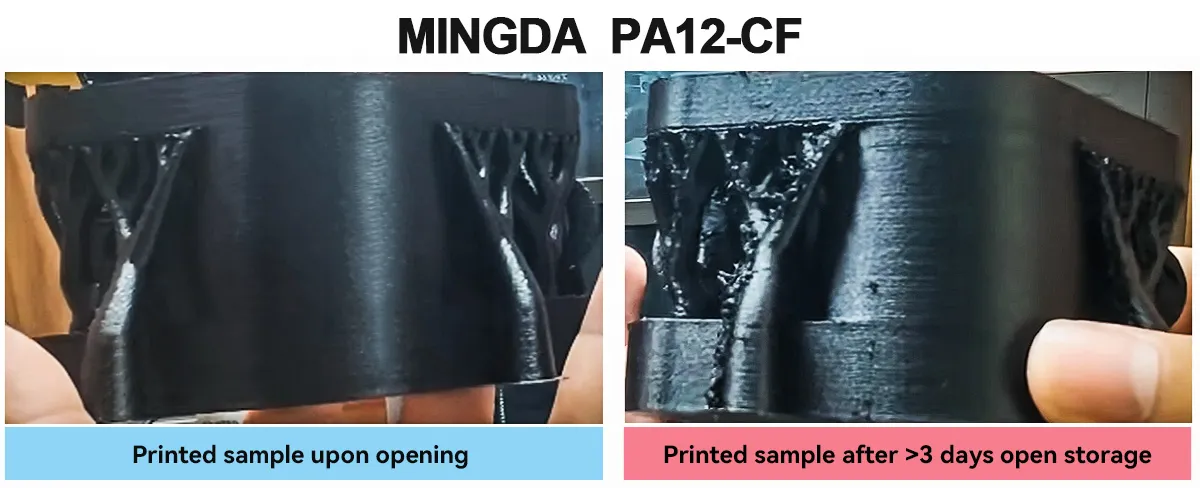
High-performance FDM filaments including PEEK, TPU, Nylon, PETG and ASA exhibit strong hygroscopic behaviour. Once opened, these spools rapidly absorb water vapour from ambient air. This moisture gain occurs invisibly and represents a latent quality risk. When damp filament reaches the hot nozzle, trapped water instantly vaporises under high processing temperature. This triggers severe print defects: surface bubbles, voids and excessive stringing, together with drastically reduced inter-layer adhesion. Parts become susceptible to layer separation and warpage. Beyond cosmetic flaws, moisture significantly degrades the mechanical performance of printed components and can lead to complete part scrapping.
2. Mid-Print Filament Depletion Cripples Overall Production Throughput
Quality issues aside, filament run-out, snapping and lack of automated material replenishment create another major bottleneck for 3D-printing operations. Traditional workflows rely on manual operator monitoring. If filament runs out or snaps without timely intervention, the print job halts immediately. At minimum, this wastes machine power and results in aborted prints. More critically, production schedules get disrupted. For long-running, large-format part builds, a single unplanned stoppage can throw away hours of print time.
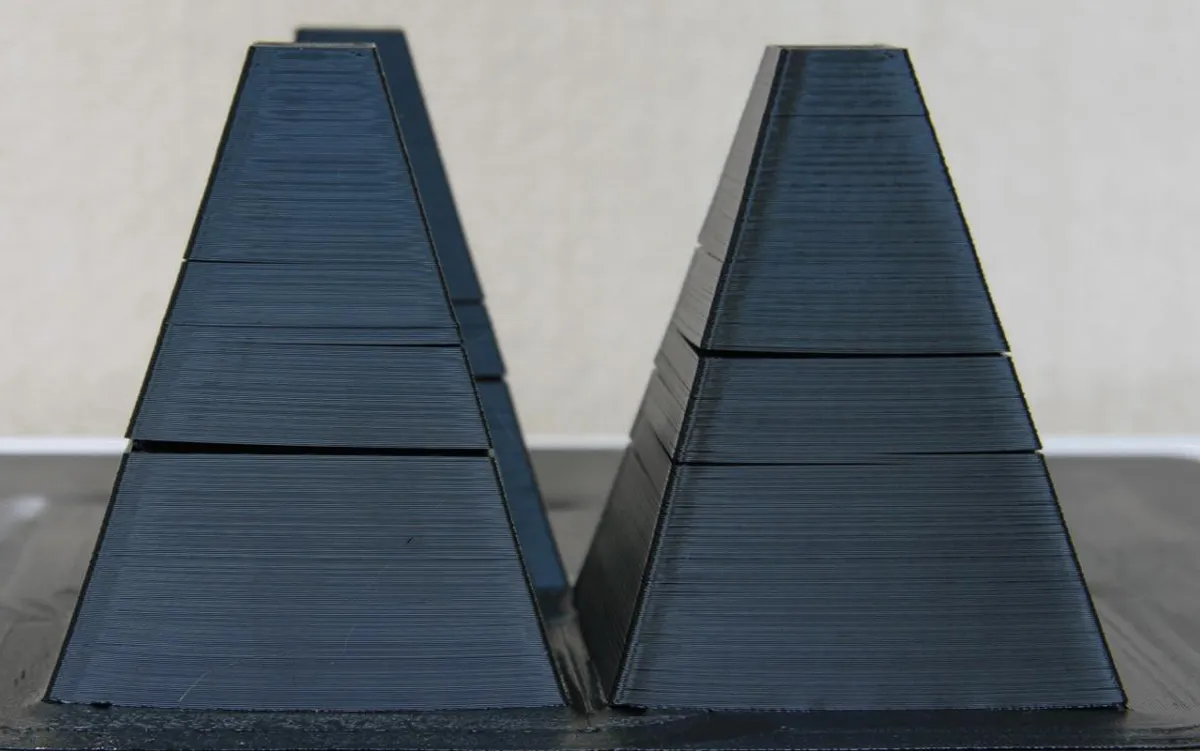
(ASA: interlayer cracking after long filament break before resume printing)
Dual Benefit Solution: Molecular-Sieve Dehumidification plus Intelligent Feeding to Resolve Industry Pain Points
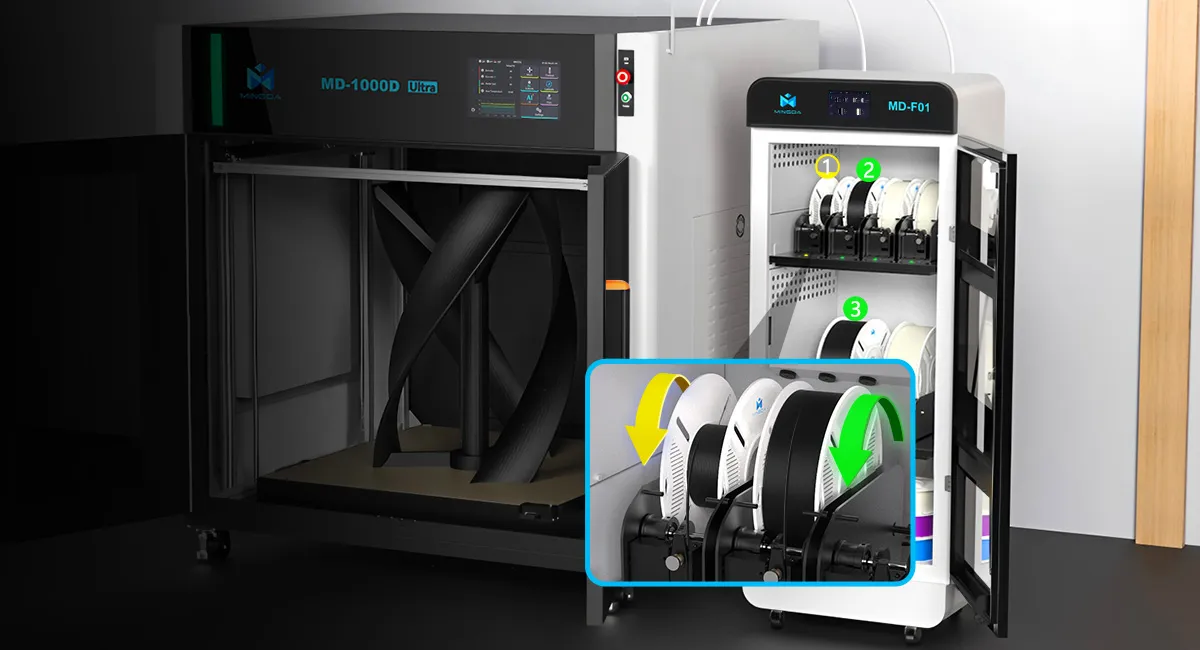
Unlike standalone drying chambers or basic filament storage cabinets, the MINGDA MD-F01 industrial-grade moisture-proof feeding cabinet directly targets part scrap caused by damp filament and productivity losses from filament interruptions. Integrating molecular-sieve humidity-regulated dehumidification and a fully-automatic spool-switching feeding system, it delivers closed-loop filament storage and active feeding to mitigate production-related risks at source.
On humidity control: The unit is fitted with an industrial-grade molecular-sieve dehumidification core. It selectively captures water molecules from the air through precise micropore adsorption. No condensation water is generated, and secondary moisture re-ingress is avoided. Its dual-chamber cyclic regeneration system maintains a stable low-humidity environment of 15 – 25 % RH, compatible with a wide portfolio of 3D-printing filaments. Opened spools can be stored long-term and accessed on-demand without repeated manual drying. The system greatly reduces moisture-driven print failures such as bubbles, layer cracking and weakened mechanical properties, supporting consistent part quality across batches and improving overall print yield.
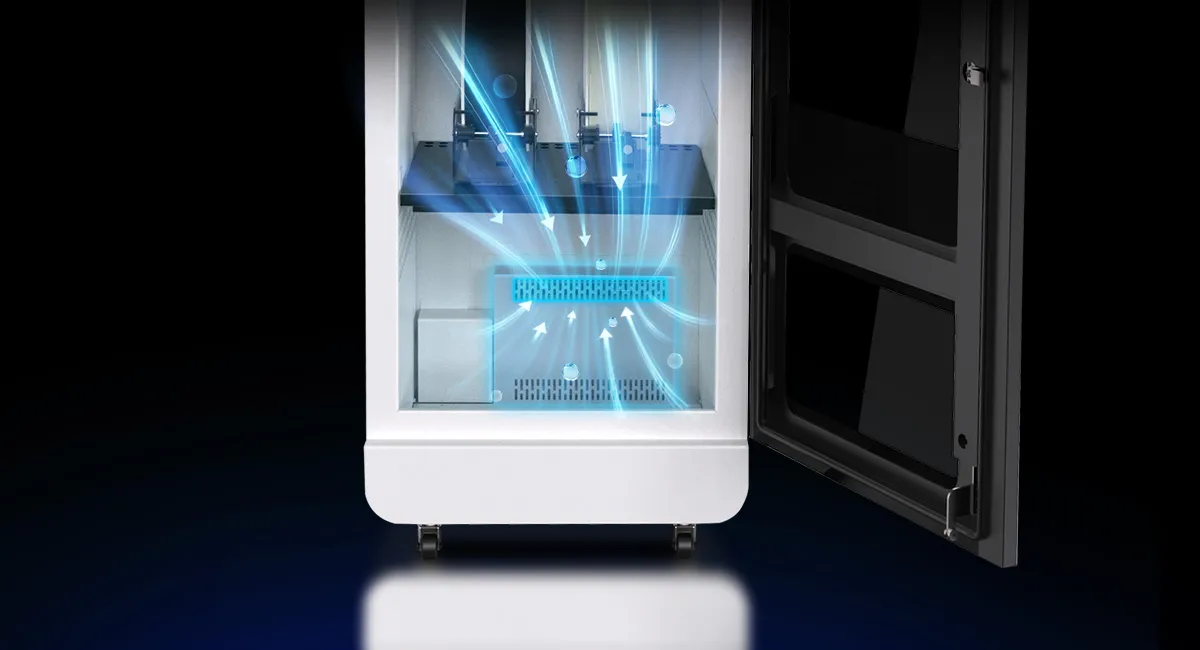
On continuous material feeding: The cabinet incorporates an intelligent automatic feeding assembly supporting simultaneous loading of multiple filament spools with automatic standby-spool switching. Filament status is monitored in real-time throughout printing. When the active spool empties or filament breaks, the system seamlessly switches to a backup spool to sustain printing, removing the need for constant on-site operator attendance. Well-suited for overnight printing, mass-production runs and multi-printer linked workflows, it minimises scrapped builds and schedule delays stemming from unexpected filament loss. It enables near-uninterrupted 3D-printing operations and maximises usable machine output.
Related News




Contact US
Product Information
Quantity
Unit
Piece
Support order samples, customization, wholesale direct, and complete payment. If the product you look for does not have corresponding customized content, pls fill out the form below to contact us, and we will reply ASAP.