


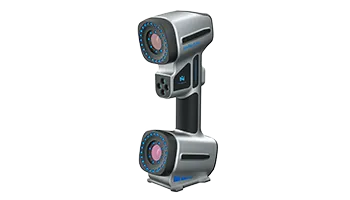




3D-Printed Aero Ducts for the Mercedes-AMG GT3 — Built on the MINGDA MD-400D+

(Caption: Equipped with custom 3D-printed front aerodynamic ducts produced on the MINGDA MD-400D+, this #79 Mercedes-AMG GT3 pushes aerodynamic efficiency to the limit on the track. )
Category: Application Case Study | Automotive & Motorsport
Equipment: MINGDA MD-400D+ Industrial 3D Printer
Material: Carbon-Fiber Reinforced High-Temp Engineering Composite (PA-CF / PET-CF)
Overview: Bringing Additive Manufacturing to GT3 Endurance Racing
In GT3 motorsport, aerodynamic balance and thermal management are decisive factors between podium finishes and mechanical retirement. When developing custom front aerodynamic and brake-cooling ducts for the Mercedes-AMG GT3, racing engineers faced a classic manufacturing dilemma: traditional carbon-fiber layup and CNC aluminum tooling require weeks of lead time and thousands of dollars per design iteration.
By deploying the MINGDA MD-400D+ industrial 3D printer, the engineering team transitioned directly from CAD modeling to track-ready composite parts—cutting tooling costs to zero and compressing production cycles from weeks to overnight.
Inside the Print: Precision Carbon-Fiber Composite Manufacturing
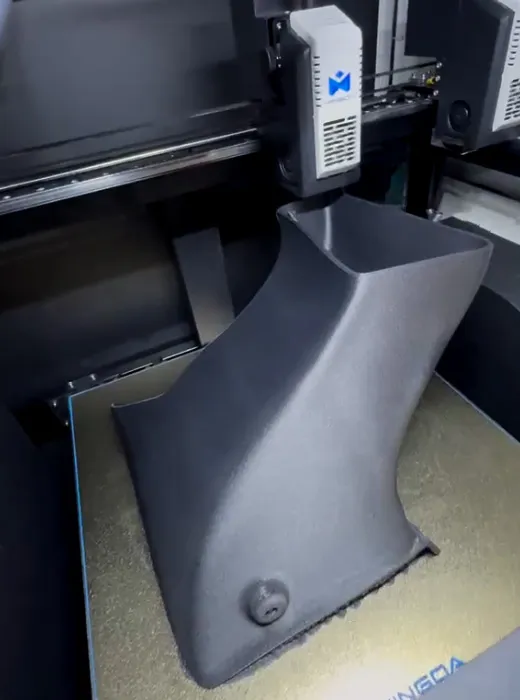
(Caption: Inside the MINGDA MD-400D+: Printing a complex curved aero duct using carbon-fiber reinforced composite with optimized tree supports and clean surface finish.)
As captured inside the build chamber of the MD-400D+, printing large, organic aerodynamic ducts demands exceptional thermal stability and motion accuracy: Single-Piece Large-Format Capacity (400 × 400 × 400 mm): Rather than splitting the duct into multiple glued segments that risk mid-race delamination, the MD-400D+ printed the entire curved intake channel as one continuous structural piece.
High-Stiffness Carbon-Fiber Surface Finish:
Utilizing high-temperature carbon-fiber reinforced filaments inside a controlled constant-temperature chamber prevented warping on steep overhangs. The resulting matte-black, micro-textured finish rivals molded composites while maintaining tight dimensional tolerances around integrated mounting bosses.
Clean Support Removal & Internal Airflow:
Advanced tree-support structures anchored the complex geometry securely to the PEI build plate during high-speed extrusion, detaching cleanly to leave smooth internal airflow walls.
Workshop Fitment: Seamless Integration with Factory Carbon Bodywork
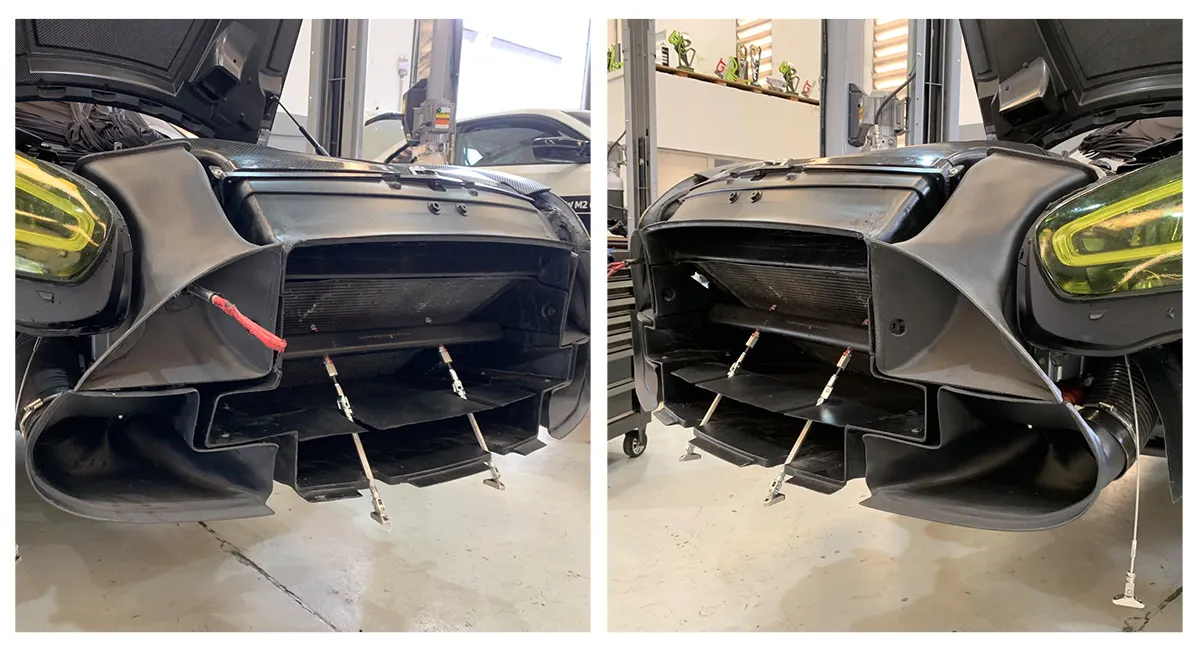
(Caption: Left & Right front aero ducts installed on the Mercedes-AMG GT3 chassis, channeling high-velocity air directly into the radiator and brake cooling hoses. )
During pit-lane and workshop assembly, the 3D-printed front aero ducts bolted directly onto the Mercedes-AMG GT3 chassis with zero post-machining required.
[Media Slot 4 — Full Front-End Assembly View]
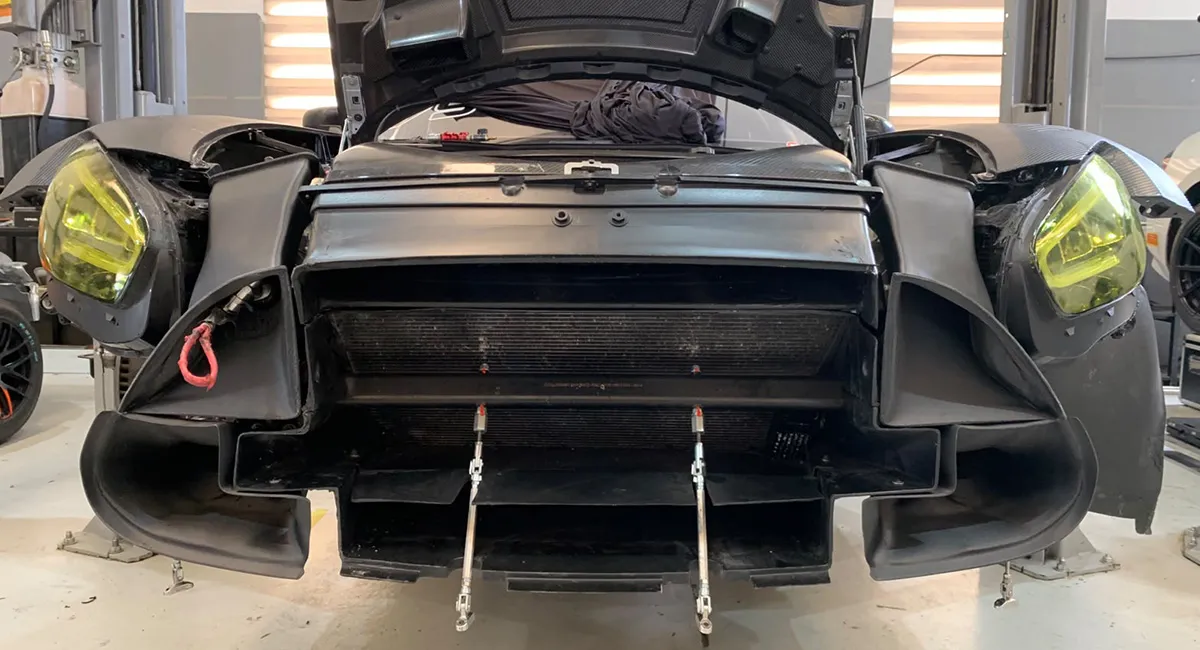
(Caption: Full front-end view showing the MD-400D+ printed aero ducts seamlessly aligned with the OEM woven carbon-fiber fenders and V8 intake assembly. )
Positioned directly beside the twin-intake V8 engine bay and beneath the woven carbon-fiber front fenders, these components must endure extreme radiant heat, debris impact, and high-downforce aerodynamic loads. The carbon-fiber composite material printed on the MD-400D+ delivered the exact heat deflection resistance and structural rigidity required for real-world track operation.
Track-Tested Performance: From CAD Revision to Cornering Grip

(Caption: On the circuit: Rapidly iterated aerodynamic components help teams fine-tune front-end downforce and cooling efficiency across multiple GT3 race chassis. )
With on-demand industrial 3D printing in-house, race engineers are no longer locked into static aerodynamic designs for an entire season:
Zero Mold Investment:
Eliminated expensive CNC metal or composite layup molds for low-volume custom aero packages.
Overnight Trackside Iteration:
Engineers can adjust duct geometry based on telemetry data and print updated parts overnight on the MD-400D+.
True 24/7 Unattended Reliability:
Equipped with industrial linear motion systems, automated bed leveling, and filament run-out sensors, the MD-400D+ runs reliably overnight to meet tight race-weekend deadlines.
Key Takeaways for Automotive & Motorsport Engineers
|
Manufacturing Metric |
Traditional Carbon Layup / CNC |
MINGDA MD-400D+ Additive Workflow |
|
Tooling & Mold Cost |
$3,000 – $10,000+ per revision |
$0 (Direct CAD-to-Part) |
|
Production Lead Time |
2 – 4 weeks |
12 – 24 hours (Overnight print) |
|
Part Geometry |
Limited by mold draft angles |
Complex internal curves in 1 piece |
|
Trackside Replacement |
High spare inventory required |
Printed on-demand anywhere |
Looking to accelerate your automotive prototyping or end-use composite manufacturing?
[Explore the MINGDA MD-400D+ Industrial 3D Printer]
Related News




Contact US
Product Information
Quantity
Unit
Piece
Support order samples, customization, wholesale direct, and complete payment. If the product you look for does not have corresponding customized content, pls fill out the form below to contact us, and we will reply ASAP.