






Insculp3D: How to achieve symbiosis of Art and Technology Through Large-Format 3D Printing
In the world of art, the chisel and the brush have long been as the tools of master artists, transforming raw materials into expressions of human thought and emotion. Yet, as technology evolves, so do the means of artistic creation. Enter 3D printing—a groundbreaking technique that is redefining the boundaries of sculpture. Known for its precision and versatility, this technology is revolutionizing how sculptures are made, shifting away from centuries-old traditional methods toward innovative processes that offer limitless possibilities in design and form.
3D printing in art represents not only a new technical approach but also a profound reimagining of how objects are created and what constitutes sculpture. It challenges conventional artistic techniques by enabling the production of highly complex and intricate forms that were once impossible to achieve. From small-scale models to large-scale installations, 3D printing is paving the way for a new era in art—where the only limitation is the artist’s imagination. In this blog, we will explore how Insculp3d utilizes MINGDA 3D’s printers to bring large-scale sculptural visions to life.
About Insculp3d
Insculp3d, based in Dubai, UAE, is a team of artists, creators, and innovators with over twenty years of experience in mastering sculptural innovation and 3D printing. By combining advanced technology with skilled artistry, they bring clients' visions to life through expertise in diverse materials and manufacturing techniques. From groundbreaking sculptures and architectural pieces to immersive art installations, the company is dedicated to transforming creative concepts into tangible realities and continually redefining the possibilities of art.

MINGDA 3D Printer Boosts Production Efficiency for Insculp 3D
“Before partnering with Mingda, we had been using consumer-grade 3D printers. But as our clients’ demands for higher-quality models grew, these machines could no longer meet our needs.” — Ashfaq, Chief 3D Designer at Insculp3d.
Reflecting on the past, Ashfaq highlighted the team’s challenges: although consumer 3D printers were affordable and reliable, they were slow and offered limited build volumes. Large prototypes often took weeks or even a month to produce. On one hand, the slow printing speed restricted efficiency; on the other hand, large models had to be divided into multiple segments for printing, which made post-processing like sanding more complicated and time-consuming.
This became particularly challenging with urgent orders—tight deadlines often led to rushed workflows, and high failure rates further delayed deliveries. The team urgently needed a new solution that could enhance production efficiency without compromising quality.
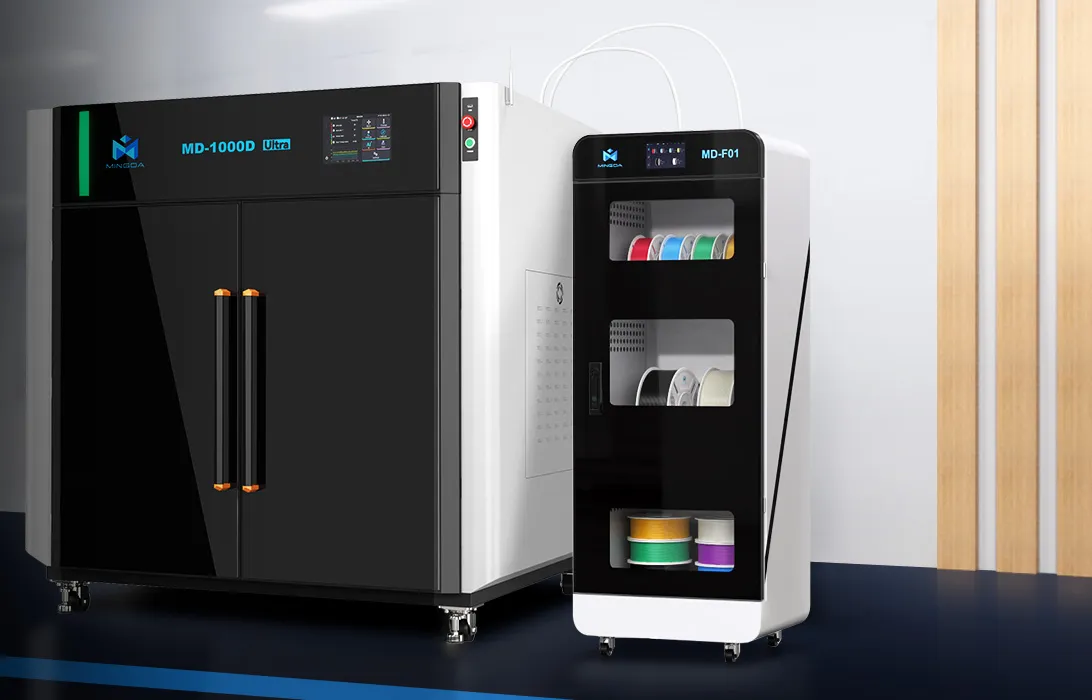
After multiple communications and test prints with MINGDA, Insculp3d ultimately selected the MINGDA MD-400D and MD-1000D—machines that turned out to be almost tailor-made for their needs.

Advantages of Using MINGDA 3D Printers for Sculpture Production

1. Flexibility and Versatility
One of the most notable advantages of using the MD-400D and MD-1000D for 3D printed sculptures lies in their IDEX dual-extruder design. Sculpture models with overhanging structures no longer rely on single-nozzle, single-material printing. Instead, different materials can be used to print the main body and support structures separately. This allows supports for overhanging sections to be easily removed, significantly improving print quality.
2. Faster Printing Speed
Compared to traditional consumer-grade printers, MINGDA 3D printers offer 2–3 times higher printing speeds. The MINGDA D-Series features an integrated nozzle design that significantly reduces filament melting time in the hot end, thereby increasing extrusion flow. Additionally, linear guide modules are installed on both the X and Y axes, ensuring stability even during high-speed movements. This efficiency is particularly beneficial for designers working under tight deadlines or producing large installations. Faster printing means artists can iterate their designs more quickly and make adjustments in real time.
3. Larger Build Volume
The D-Series printers are capable of handling substantial print volumes, enabling the creation of impressive large-scale artworks that would be time-consuming and costly to produce using traditional methods. The ability to seamlessly print large objects without the need for assembly is a significant advantage for designers.


(MD-1000D printed: Angry Teddy Bear, 704*654*858 mm, 8 days printing + 2 days polishing)
Since introducing the MINGDA MD-400D and MD-1000D, Insculp3d has not only reduced its production cycle from weeks to just a few days but has also achieved superior product appearance and precision. This advancement has strengthened trust among existing clients and attracted new business opportunities. For the company, these machines represent far more than mere equipment—they embody a comprehensive upgrade in efficiency and quality across the entire operation.
Conclusion
The story of Insculp3d proves that in the 3D printing industry, speed and quality have never been a trade-off. With the advanced intelligent equipment from MINGDA 3D, they have found the optimal balance between “fast” and “excellent,” as well as an accelerated path to the future market. When you move faster than the market, you get one step closer to your customers.
Related News



Contact US
Product Information
Quantity
Unit
Piece
Support order samples, customization, wholesale direct, and complete payment. If the product you look for does not have corresponding customized content, pls fill out the form below to contact us, and we will reply ASAP.